Russian-Speaking Influencer Marketing Overview 2024

Industry Report Russia & CIS: social media analytics, top bloggers, trends, and legislation for brands

Required field
Required field
Required field
Required field
Required field
Required field
Required field

Executive Summary

The report "Russian-Speaking Influencer Marketing Overview 2024" explores how the events after 2022 reshaped influencer marketing in Russia and the CIS, setting it apart from global patterns.

The blocking of foreign social platforms has altered the digital landscape and the dynamics of influencer engagement. Bloggers moved to Russian services such as VKontakte and Telegram, while integrations on YouTube and Twitch became more native and direct.

Despite the challenges, the market adapted quickly. In 2023, Russian influencer marketing reached 15.75 billion rubles, domestic social networks took a 56% share, and the number of advertising integrations with bloggers grew 1.5 to 2.5 times.

Each platform has its own audience, formats, and leading creators, from entertainment on VKontakte and news-style channels on Telegram to live streams on Twitch and niche placements on Dzen.

This report guides global marketers through platform analytics, top bloggers, 2024 trends, ad labeling rules, and key CIS markets.

Contents

1. Russian Digital Market Overview

2.1 Global Russian-Speaking Population: A Comprehensive Numerical Analysis

2.2 Assessing the Volume of Russia's Influencer Marketing Industry

2.3 Russia and the World: Key Variances in Digital Ecosystems

3.1 How YouTube Became Russia's Leading Platform

3.2 VKontakte's Commitment to Author Diversity and Support

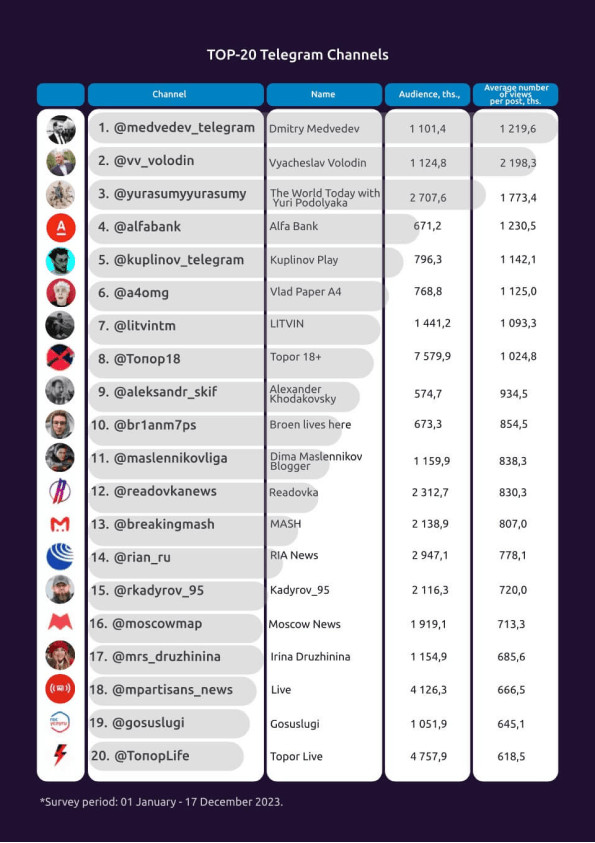
3.3 Promotion in Telegram and its Specifics

3.4 Why Instagram Shouldn't Be Underestimated?

3.5 Influencer Engagement Projects in Odnoklassniki

3.6 Shifting Focus to Native Advertising Integrations on Dzen

3.7 Russian Twitch Stability has Been Proven for Years

3.8 Summary highlights

4. Trends 2024 in the Russian Influencer Market: Key Focus Areas for Brands

5. Understanding Blogger Advertising Through the Lens of Russian Legislation

6.1 Kazakhstan

6.2 Uzbekistan

6.3 Azerbaijan

6.4 Belarus

7. Conclusions

  • 1. Russian Digital Market Overview
  • 2. Insights into Russia's Influencer Marketing Arena
  • 3. Russian Social Media Landscape and Blogger Influence
  • 4. Trends 2024 in the Russian Influencer Market: Key Focus Areas for Brands
  • 5. Understanding Blogger Advertising Through the Lens of Russian Legislation
  • 6. CIS Influencer Marketing Overview
  • 7. Conclusions
Russian Digital Market Overview

Influencer Marketing Market Size

  • $1.7B in 2016
  • $16.4B in 2022
  • ~$21.1B expected in 2023

Brands remain committed to the channel:

  • 83%+ of brands consider influencer marketing effective
  • 67% of businesses with an influencer budget plan to increase it in 2023
  • 23% of companies intend to spend over 40% of their marketing budget on influencer campaigns

The Most Common Channel Used by Influencer Marketing Brands

Share of brands using each channel:

  • TikTok: 55.5%, taking first place
  • Instagram: 50.8%, dropping to second place
  • Facebook: 42.1%, down from 50% a year earlier
  • YouTube: 38.3%, down from 44%

Summary: Global growth continues, but Russia and the CIS follow their own path.

Insights into Russia's Influencer Marketing Arena

Russia's influencer market has adapted to the major digital disruptions that followed 2022.

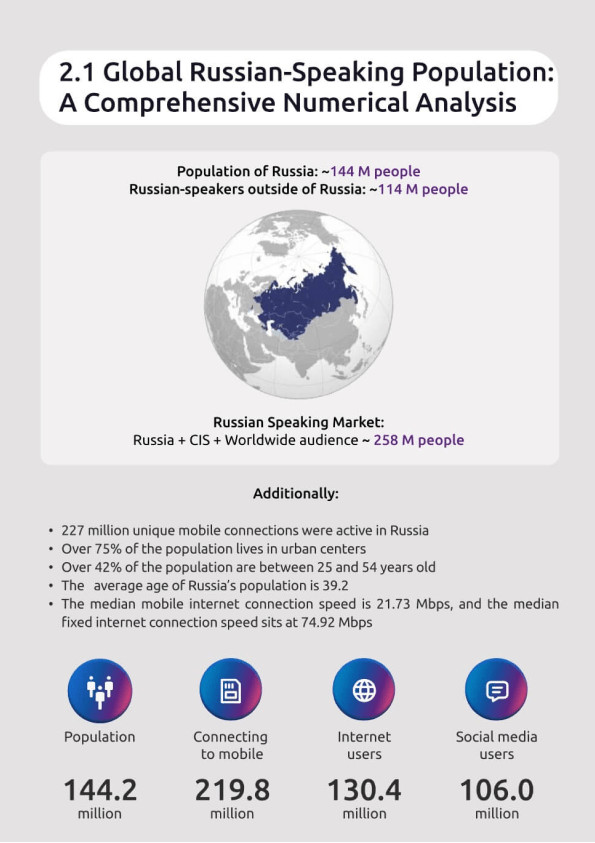
Global Russian-Speaking Population: A Comprehensive Numerical Analysis

  • Russia: ~144M people, 88.2% online in 2023 (127.5M)
  • ~114M Russian speakers outside Russia
  • ~258M Russian-speaking market worldwide (Russia + CIS + diaspora)

Assessing the Volume of Russia's Influencer Marketing Industry

  • 15.75B rubles: influencer marketing and native advertising market size in 2023
  • 1.5 to 2.5 times growth in advertising integrations with bloggers
  • 56% share held by Russian domestic social networks
  • 63 platforms in the segment, 28 of them local

Russia and the World: Key Variances in Digital Ecosystems

  • Google does not show ads in Russia, including on YouTube
  • TikTok restricts new content and ads for Russian users
  • Facebook and Instagram are blocked in Russia
  • YouTube monetization halted and European brands exited
  • VKontakte and Telegram became the popular platforms

Summary: A large Russian-speaking audience and a resilient market rebuilt around local platforms.

Russian Social Media Landscape and Blogger Influence

By average monthly reach in 2023, the top three platforms in Russia were:

  1. YouTube
  2. VKontakte
  3. Telegram

How YouTube became Russia's leading platform

  • 94.78M monthly reach; 42.9% of Russians watch daily for about 86 minutes
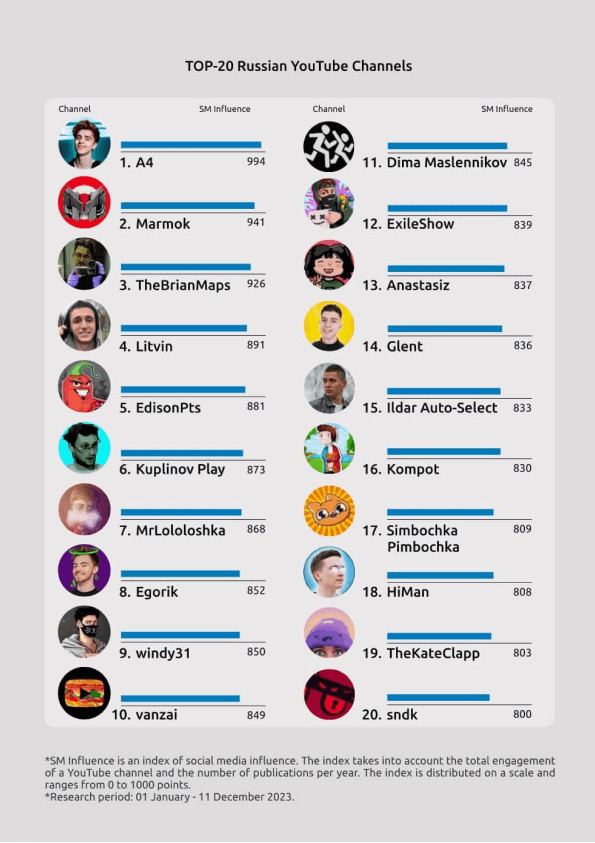
  • Top channels: A4, Marmok, TheBrianMaps, Litvin, EdisonPts

VKontakte's Commitment to Author Diversity and Support

  • 89M monthly users, 54.6M daily, 2.41B videos watched per day
  • Top bloggers: veydi_rush, Kara_kross, Dasha Doshik, Valya Karnaval

Promotion in Telegram and its Specifics

  • 45.8% of Russians use it daily; 58% men, core age 25-34
  • Formats: Telegram Ads, seedings, and Yandex.Direct placements

Why Instagram Shouldn't Be Underestimated?

  • Monthly reach fell to 25.1M by October 2023, yet brands and micro-bloggers stay active

Influencer engagement projects in Odnoklassniki

  • 40M monthly users; the platform nurtures micro-bloggers with free shows

Shifting Focus to Native Advertising Integrations on Dzen

  • 80M monthly audience, 25% daily use; strong for spot placements and news-style content

Russian Twitch stability has been proven for years

  • Russian Twitch ad market exceeds 1B rubles a year
  • Top advertisers: Winline, BetBoom, Tornado Energy, Do-Do Pizza, Tinkoff

Summary highlights: Bloggers moved to local platforms, raised rates by 30%, and embraced video and news-style formats.

Trends 2024 in the Russian Influencer Market: Key Focus Areas for Brands

After the 2022 blocks, bloggers experiment with platforms and formats:

  • Duplicating content across several platforms at once
  • Doubled reach of advertising integrations
  • Exclusive shows produced with Russian platforms
  • Rutube and VKontakte tools for moving content from foreign services

Example: Vlad Paper A4 promoted the Games of the Future event on both Telegram and VKontakte.

Brands increasingly choose new collaboration formats:

  • Long-term partnerships and ambassadorships (Haier with Irena Ponaroshku)
  • Rising role of micro- and nano-bloggers (Premiata with Alena Savko)
  • Emotional, immersive integrations and Twitch live streams

What are the complexities of Russian influencer marketing right now?

  • 48% of bloggers earn through Instagram, threatened by VPN blocking from March 1, 2024
  • Blocking risks on YouTube and repeat-view counting on VK Video
  • Rutube server capacity limits and unclear Dzen and Odnoklassniki advertising

Summary: 2024 is expected to complete the move of creators to local platforms, with new challenges.

Understanding Blogger Advertising Through the Lens of Russian Legislation

Since September 1, 2022, all online ads must be labeled and reported to ERIR before and after a campaign.

Data communication subjects and objects

  • Advertisers, ad systems, agencies, and publishers provide data
  • Advertising Data Operators (ADO) transmit it and issue tokens
  • ERIR, the Unified Registry of Internet Advertising, stores it
  • Roskomnadzor, the Federal Anti-Monopoly Service, and the Federal Tax Service access it

Labeling is necessary in any of these situations:

  • Promoting your products on your website, app, or social media page
  • Placing ads with another site, social media page, or blogger
  • Placing ads through an agency

Advertising is information that:

  • Is addressed to an indefinite circle of people
  • Aims at attracting attention to and promoting an object

Everything considered advertising must be labeled, except:

  • Social advertising
  • TV and radio ads placed online without changes
  • Own-product ads in email newsletters and push notifications: labeled "Advertising", no ERIR submission

How do advertising systems and agencies work with ad labeling?

  • Yandex.Direct and VK Ads generate tokens automatically via API
  • Telegram channel ads and Instagram reels require an external ADO
  • RMAA Agency handles ad marking for its clients
  • Especially helpful for micro-bloggers without compliance experience
  • Streamlined processes reduce paperwork for clients

Summary: Every online ad, including blogger integrations, must be labeled and registered in ERIR.

CIS Influencer Marketing Overview

Kazakhstan

  • 17.3M of 19.5M people online; Instagram (10.95M) and TikTok (10.8M) lead
  • Top creators: Nazerke Almukhametova, Erke Esmahan, Homa, Kika Kim

Uzbekistan

  • 26.74M internet users, 9.0M social media users (+44%)
  • Instagram leads with 4.7M users; 65% of internet users open Telegram daily
  • 70% of social media users are registered as men
  • Top bloggers: Otabek Umarov, Sariq Bola, Shahzoda

Azerbaijan

  • 8.92M internet users (86%), 4.15M social media users
  • Digital market grew 8% in 2023
  • Instagram leads with 3.25M users
  • Main audience aged 25-44; 98.3% access social networks via mobile
  • Elkhan Khalafov (Sheemamoto) leads Russian-language content

Belarus

  • 8.27M internet users, 87% penetration
  • Internet holds 54% of the advertising market
  • 44% of users turn to social networks for information
  • Top bloggers: Chingiz Allazov, Andi Taranik, A4, Glent

Summary: Open access to Instagram and TikTok, with Russian still widely used.

Conclusions
Conclusions

The Russia & CIS market:

  • Evolves on a path distinct from global influencer trends
  • Has shifted toward local platforms
  • Shows unique audience preferences

For brands this means:

  • A personal approach to each market
  • Bespoke marketing strategies
  • Careful selection of the most impactful influencers
  • Management of all aspects of influencer campaigns

Overall: Local trends and platforms define success with Russian-speaking audiences.

Ready to launch? Work with an influencer marketing agency in Russia.

This White Paper serves as a roadmap for brands aiming to leverage influencer marketing in the Russian-speaking world, focusing on legal, cultural, and strategic frameworks. Our aim is to unravel the intricacies of this market, delivering insights and practical tactics for impactful engagement. Whether influencer marketing is your primary promotional tool or part of a broader strategy, this report provides essential insights for successfully engaging with the dynamic Russian market, from initial exploration to enhancing established connections.

Vadim Tylik CEO RMAA Agency