UGC in Russia: A Practical Guide to Reviews, Sales, and Compliance
Key Takeaways
- UGC is not one format. Customer reviews, videos produced to a brand brief, and paid creator integrations differ in rights, ad labeling, and KPIs.
- Reviews can materially affect sales. In an Easy Commerce study of more than 100,000 Ozon and Wildberries listings, reviews made the largest contribution among the factors analyzed, at 23% to 24%.
- Buyers value authenticity. Recent reviews with specific details and photos are more persuasive than a feed made up only of five-star ratings.
- Secure usage rights when you collect the material. Publishing a review does not give the brand permission to reuse the author's text, photos, or videos in its own communications.
- UGC requires a clear strategy and measurement framework. Brands should collect material for a specific objective and sales-funnel stage. Results should be assessed through conversion, engagement, or repeat purchases.
Russians trust feedback from real buyers more than influencer reviews. March 2026 data from the Russian Public Opinion Research Center (VCIOM) shows that 72% of respondents consider customer reviews a useful source of product information. Influencer reviews score 39%, while 34% value recommendations on specialist websites. On March 25, 2026, Russia's Federal Antimonopoly Service, or FAS, stated that advertising on Telegram and YouTube violates the law. The regulator also introduced a transition period through December 31, 2026. From January 1, 2027, marketers should treat paid placements on these platforms as high risk unless the regulator clarifies its enforcement approach. Organic UGC usually does not qualify as advertising, so it can remain a lawful way for brands to stay present on Telegram and YouTube, two major platforms of Runet, the Russian-language internet.
This guide explains how to build a user-generated content (UGC) program for Russia that delivers measurable results without creating legal risk.
What Counts as UGC: Reviews, Creators, Advertising, and Influencer Marketing
In Russia, marketers use the term UGC for at least five different practices. The distinction matters because each one has different rules for ownership, ad labeling, and performance measurement.
Genuine UGC. Customers create it independently, without payment or instructions from a brand. Typical examples include marketplace reviews, photos on personal accounts, comments, and unboxing videos. The author owns the rights. Ad labeling is not required at this stage. It becomes necessary if the company later uses the material in a publication that qualifies as advertising, including in the brand's own channels. Relevant metrics include the reusable share and its effect on conversion.
UGC media. This category includes articles and long-form posts on user publishing platforms. Habr and vc.ru focus on technology and business. The entertainment site Pikabu centers on community stories, while the blogging platform Dzen combines publishing with content recommendations. These sites have their own editorial rules, and articles can remain visible for years. Habr treats publications designed to promote a product or generate leads as advertising. It allows such material only through a paid corporate blog.
UGC-style advertising creatives. These videos follow a brand brief but are made to look like customer reviews. A creator may have no followers at all, while rates on open exchanges start at several thousand RUB per video. This is advertising production, not user-generated content. A contract should define usage rights, ad labeling is mandatory, and performance should be measured like any other advertising creative.
EGC, or employee-generated content. Employees create this material, usually at the employer's initiative. Its legal status is therefore closer to advertising than to genuine customer UGC.
Influencer marketing. A company pays a creator with an established audience for a placement. It is related to UGC, but it follows a different commercial model and has its own legal obligations.
Confusing genuine UGC with UGC-style advertising costs money and creates compliance risk. A company may order a package labeled 'UGC' and receive videos made to a detailed brief. The budget treats them as customer-generated material, while the law treats them as advertising assets with full advertiser obligations. The distinction is grounded in Part Four of the Russian Civil Code. Under Article 1229, an author's silence does not constitute consent to use their content. The Federal Antimonopoly Service (FAS) guidance 'Concept of Advertising', approved by Order No. 821/23 on November 14, 2023, states that information qualifies as advertising when it is intended to draw attention to a specific product and distinguish it from comparable offers.
Unless stated otherwise, this guide uses UGC to mean genuine customer-created content.
Why UGC Matters for Trust and Sales
Sales impact. Reviews made the largest contribution to marketplace sales in an Easy Commerce analysis of more than 100,000 products on Ozon and Wildberries, two of Russia's largest marketplaces, from November 2024 to January 2025: 23% of the sales weight on Ozon and 24% on Wildberries. Price and discount accounted for 19% on Wildberries. On Ozon, they carried 17% and 15% of the weight, but only in expensive categories such as furniture, games and consoles, and construction and repair. Product ratings accounted for 5% on Ozon and 8% on Wildberries. Buyer feedback had an especially strong effect on Wildberries in the Health, Children's, and Women's categories.
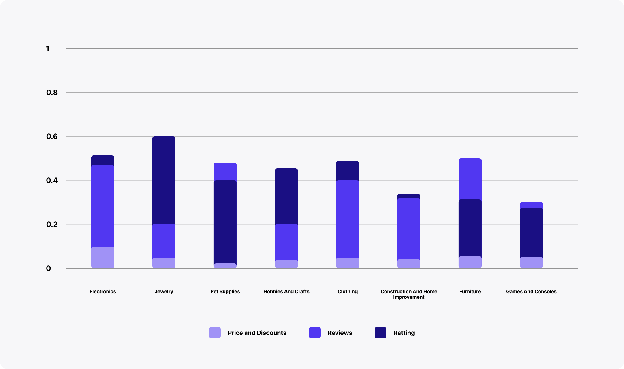
Weight of price and discounts, reviews and ratings in marketplace sales by product category. Source: Easy Commerce.
How customers use reviews. Ozon research from May 2026, based on a survey of more than 1,000 of its customers, found that 66% always read customer comments before buying and another third do so often. Half of respondents consider a rating of 4.8 or above comfortable for purchase, while a third use 4.5 to 4.7 as their benchmark. Buyers typically spend three to five minutes reading opinions and pay the closest attention in clothing and footwear, technology and electronics, and beauty and health. Only 9% consider the country of manufacture.
What builds trust and what raises suspicion. Buyers look for authenticity rather than constant praise. According to a survey by the Megamarket marketplace of customers who had placed three or more orders, 58% become cautious when every rating is positive, and 63% would not buy when negative comments outnumber positive reviews with photos. Recent reviews matter to 59% of respondents, and buyers expect a product to have at least ten ratings.
Volume and growth. User-generated content in Russia is now growing through marketplaces and review platforms rather than messaging apps. Brand Analytics, a social media monitoring company, recorded 85.6 million active authors across Russian social media in September 2025, the highest figure since monitoring began in 2013 and 14.2% more than a year earlier. Telegram stopped growing for the first time in five years. The share of authors on marketplaces and review sites rose from 17% to 21%, matching the share of authors on VKontakte, or VK, Russia's largest social network. The share of posts on marketplaces and review sites also rose from 5% to 8%.
What Changed in Rules and Platforms in 2026
Advertising status by platform. Paid advertising on blocked and throttled services now violates advertising law. The enforcement timeline differs by platform. Since September 1, 2025, advertising on Instagram and Facebook has been fully prohibited. Part 10.7 of Article 5 of the Federal Law on Advertising sets the ban, and companies that break it face fines of up to RUB 500,000. On March 25, 2026, the Federal Antimonopoly Service (FAS) applied the same interpretation to Telegram and YouTube in official guidance. It also introduced a transition period through December 31, 2026 without penalties. From January 1, 2027, enforcement is expected to rely on this guidance.
The FAS guidance on Telegram and YouTube is not a formal regulation, and there is no court practice testing it yet. The regulator's position may change. Companies should therefore build 2027 plans with a compliance buffer rather than rely on the narrowest possible reading of today's guidance.
Platform access. Audiences remain active on several restricted services, but new companies cannot rely on normal organic growth there. On February 10, 2026, Russia's communications regulator Roskomnadzor confirmed that it was throttling Telegram and said restrictions would continue. In June 2026, the Russian messenger MAX became the country's largest messenger by monthly reach, with 86.2 million users against Telegram's 75.7 million, according to Mediascope, a media measurement company. TikTok has blocked video uploads from Russian IP addresses since March 2022, and content from the country does not enter global recommendations. Even so, Brand Analytics reported that monthly Russian TikTok authors rose from 0.14 million to 0.61 million during 2025. Since April 15, 2026, marketplaces, social networks, and banks have restricted access through VPNs. Mediascope found that most of these services lost less than 5% of their audience in April 2026, although Digital Budget estimated that Wildberries lost 10% of its mobile traffic.
UGC publishing standards have tightened. Habr's July 2026 rules now explicitly prohibit companies from disguising promotion as user material outside a corporate blog. The restrictions also cover promotional logos, names, and links in usernames or avatars.
New marketplace regulation. The new Platform Economy Law makes buyer reviews even more important for international companies. Federal Law No. 289-FZ on the platform economy took effect on October 1, 2026. Article 7 requires marketplace operators to identify products offered by a foreign partner and explain relevant purchase conditions. For a foreign brand, customer reviews are the main counterweight to that disclosure at the point of choice.
UGC Strategy for Russia: Seven Decisions to Make Before Launch
Most brands begin UGC work by asking where to get the content. The better starting point is why they need it and where it should influence the purchase journey.
Step 1. Define the Business Goal, Not the Format
'Trust' is not a measurable objective for a brief. A useful goal could remove a specific objection during consideration. For example, buyers may ask whether the size fits or how the product looks in real life. Another option is to build social proof on product pages before paid traffic starts. UGC can also reduce creative production costs or support retention through a community. Each task needs its own format, channels, and metric. Without a clear choice, teams collect unrelated material and cannot evaluate the result.
Step 2. Define UGC's Role in the Sales Funnel
A marketplace review and a long-form article on Dzen or Habr solve different problems. They also sit at different stages of the customer journey. An article should not be measured with review metrics. One brand may use several types of UGC at once, but each needs a defined role.
| Funnel stage | Role of UGC | Typical format | Best placement | Primary metric |
|---|---|---|---|---|
| Awareness | Shows that people use the product | Clips, tagged posts, livestreams | Social networks, video platforms, gaming communities | Mention reach, share of organic mentions |
| Consideration | Removes purchase objections | Photo reviews, Q&A, detailed reviews | Marketplaces, review platforms, maps | Product-page conversion, rating, share of photo reviews |
| Purchase | Provides the final reason to buy | Recent reviews, video reviews | Product page, landing page | Add-to-cart and purchase conversion |
| Retention | Turns customers into active participants | Community posts, contest entries, guides | Brand communities, UGC media | Repeat purchases, community activity |
A common mistake is collecting awareness material while expecting a result at the consideration stage. Social clips do not raise marketplace product-page conversion. Photo reviews on the listing are the format designed for that job.
Step 3. Choose How You Will Generate Content
Each collection method has its own balance of volume, quality, and cost. It also produces a different result.
Points-for-reviews programs. Ozon, Wildberries, and Yandex Market, Yandex's e-commerce marketplace, let sellers reward verified buyers with points for leaving feedback. Points-for-reviews programs are the only incentive mechanism that Ozon, Wildberries, and Yandex Market explicitly sanction. The mechanism delivers volume quickly at a predictable cost. Depth is usually moderate because customers write for the reward rather than to tell a story. The main advantage is verification: every submission is linked to a confirmed purchase.
Post-purchase requests. An email, push notification, or QR code inside the package can ask buyers to share their experience. The method is almost free but works slowly. Responses are often honest and detailed because they come from people with something to say. A new product may need several months to receive its first ten reviews.
Contests. They create a spike rather than a steady flow. A mass prize draw produces high volume but low quality. A contest with an entry barrier, such as filming a video or writing a detailed post, usually produces fewer submissions. The mistake is treating contests as a permanent source.
Creator programs. This is incentivized material rather than advertising made to a strict brief, although the boundary can be narrow. The creator receives a reward for meeting the conditions but films in their own way. For Tencent, RMAA Agency managed the PUBG Mobile Next Star creator incentive program. The team recruited Russian-speaking and European creators, supported them through game missions, and administered payments and in-game rewards. Participants published clips with required hashtags on their own channels. Over six months, the program produced 266 hours of video and about five million views.
Community as the environment for UGC. UGC appears where people have someone to share it with. Without a community, a review has no reader and a post has no audience. For Korean beauty brand Farmstay, RMAA Agency built brand communities in Russia across VK, Telegram, and Instagram alongside influencer campaigns. The project reached 13,400 followers in eight months and generated 1.19 million views from influencer placements.
What not to do. Avoid review exchanges and services that promise to fill empty product pages.
Step 4. Secure Content Rights Before You Need the Content
Rights belong in the strategy because brands must secure them during collection. They should not wait until the marketing team decides to reuse the material. Using a customer image in advertising without the author's permission can violate exclusive rights. Russia's Civil Code also states that a creator's failure to object does not mean consent. In practice, brands need three controls. Contest and review-program terms should include a license for reuse. A recognizable person in the material requires separate permission. The company should also keep a register showing which rights it holds for every asset and for how long. Without that record, a large archive may be impossible to use.
Step 5. Moderate Content and Respond to Negative Reviews
A perfect review feed can create suspicion rather than trust. In a Megamarket survey, 58% of buyers become cautious when every rating is positive, and 63% would not buy when negative comments outnumber positive reviews with photos. Two rules follow. First, do not delete criticism. Answer it publicly and directly. In our experience, future buyers read the brand's response, and it often carries more weight than the original comment. Second, collecting image-based reviews matters more than chasing raw volume. Written selection criteria should cover product relevance, other brands visible in the frame, image quality, and usage rights. Our guide to online reputation management in Russia covers review monitoring and responses in more detail.
Step 6. Put UGC Where Customers Make Decisions
Collected UGC works only when customers see it at the moment of choice. Product pages, landing pages, review sections, and brand communities are the main placements. Paid promotion can extend reach, but two legal limits matter in 2026. First, UGC becomes advertising when a company uses it in paid promotion, so statutory labeling rules apply. Second, paid promotion on Instagram is already prohibited. Under current guidance from the Federal Antimonopoly Service (FAS), enforcement for Telegram and YouTube begins on January 1, 2027. Organic UGC on Telegram and YouTube remains outside the ban and is a lawful way for brands to maintain a presence there.
Step 7. Set the Metric and Build a Feedback Loop
Choose the UGC metric together with the business goal, before launch. If the task is to remove a purchase objection, compare product-page conversion before and after the program rather than counting reviews.
What If You Have No UGC Yet?
Having no UGC is normal for an international brand during its first months in Russia. A realistic first-quarter plan starts with at least ten recent photo reviews for each key SKU. In a Megamarket survey, buyers expect a product to have at least ten ratings. Use marketplace points-for-reviews programs together with post-purchase requests. At the same time, secure usage rights in the program terms and respond to negative feedback from the start. Do not wait for organic Habr coverage and do not buy reviews. Organic mentions come later, while purchased feedback can create a problem that costs more to fix than honest collection would have cost.
UGC Formats: An Engagement Ladder
Different types of UGC demand different levels of effort from the person creating them. A star rating takes seconds, while a Habr article can take an evening. Think of this progression as an engagement ladder. Each step asks more of the user and gives the brand a stronger asset.
Level 1. Rating without text. This is the most common format and the weakest on its own. Ratings influence product choice, but in the Easy Commerce data on Ozon and Wildberries they accounted for 5% to 8% of the sales weight, against 23% to 24% for reviews.
Level 2. Short review. Two or three sentences add volume. They also help a listing reach at least ten ratings, the minimum buyers expect in the Megamarket survey.
Level 3. Review with a photo or video. This is where trust starts to build. Buyers use photo reviews to balance negative feedback. International brands often lack this format on key product pages when they first enter the market.
Level 4. Detailed review. An unboxing, comparison, or one-month usage report lives longer than a short comment. It supports consideration on the product page and can continue working through search.
Level 5. Community post or reply to another customer. At this point, the person takes part in the community. This format mainly supports retention.
Level 6. Long-form article on a UGC platform. This is the highest rung. It requires expertise and time from the author and must pass platform moderation. In return, the brand gains a searchable asset that can work for years. Very few users reach this level organically, so it needs a separate approach.
The practical value of the ladder is that brands can move people upward over time. A buyer who has already left a rating is more likely to respond to a review request than a random visitor. Someone who submits a photo review may later become a brand ambassador. Match collection methods such as points-for-reviews programs, post-purchase requests, contests, and creator programs to the appropriate rung instead of applying every tactic to everyone.
Where to Collect and Use User-Generated Content
At the start of 2025, e-commerce platforms were Russia's leading source of product information before buying, named by 46.1% of respondents. Search platforms ranked second at 31.8%, including Yandex Maps, a major Russian maps and local search platform. Reviews and ratings remain part of this decision journey. A survey by the Russian Quality System (Roskachestvo) found that 43% of online buyers consider both reviews and ratings, and another 16% rely on only one of them. Brands therefore need a presence where people compare other customers' experience. These touchpoints include marketplaces, search, and maps for offline businesses and service providers.
Marketplaces. Ozon, Wildberries, and Yandex Market are where buying decisions happen (see our article on how Russians shop online). Material collected elsewhere should lead customers back to the relevant product listing. For Poizon, RMAA Agency ran 16 creator placements across five platforms and generated more than 801,000 views. That traffic led to marketplace pages, where buyers could read feedback from other customers. Creator content brings people to the listing, and customer reviews help close the sale.
Maps and review platforms. Yandex Maps, the 2GIS business directory, and the review sites Otzovik and IRecommend form the second layer at the consideration stage. They are especially important for stores, restaurants, and service businesses. Text reviews and photos are the main formats. Paid promotion is allowed when the required ad labeling is in place. A company's reply appears alongside the customer's comment, so responding well to criticism can directly influence the next buyer.
Social Networks and Messaging Apps
In 2026, legal status is the first factor to consider when choosing social networks and messaging apps.
VK, Odnoklassniki, and MAX. Advertising remains legal on these Russian platforms when companies follow ad labeling requirements. VK, the country's largest social network, leads in active authors and content volume in the cited Brand Analytics data. MAX is a Russian messaging platform with some news-consumption use cases associated with Telegram. In June 2026, it became the country's largest messenger by monthly reach, according to Mediascope. VK, Odnoklassniki, and MAX support all major formats and fit awareness and retention best.
Telegram. Russia's communications regulator Roskomnadzor has throttled Telegram since February 2026. The Federal Antimonopoly Service (FAS) treats commercial advertising as unlawful, with a transition period through December 31, 2026. Organic brand communities remain outside the ban. Companies can continue running them, but under the current guidance they should not buy influencer seeding after the transition period ends.
Instagram and Facebook. Russia has prohibited advertising on these services since September 1, 2025. Brand Analytics still ranks Instagram second by the number of Russian authors, so UGC continues to appear there. Brands can monitor and consider it, but they cannot amplify it through sponsored promotion.
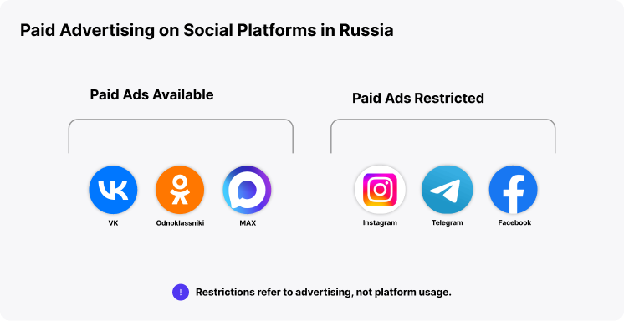
Paid advertising on social platforms in Russia
Video Platforms
In 2026, video platforms divide by legal status: paid promotion is legal on some services and banned or restricted on others.
VK Video, VK Clips, Rutube, and Dzen. Paid promotion remains legal on these Russian services when companies follow the relevant rules. According to Brand Analytics, Dzen's content volume grew 7.4% in 2025, while Rutube lost 14.6% of authors and 41.1% of published material. Audiences still watch, but creator activity remains weak.
YouTube. Russian authorities have throttled the platform. Advertising on YouTube falls under the Federal Antimonopoly Service (FAS) transition period through December 31, 2026. Some creators remain active, and Brand Analytics recorded 7.1% growth in the number of Russian authors during 2025.
TikTok. The service has blocked standard video uploads from Russian IP addresses since March 2022. Posts still appear through workarounds, but a new brand cannot rely on organic growth there.
UGC Media: When User Content Becomes a Long-Form Article
UGC publishing platforms such as Habr, vc.ru, Pikabu, and Dzen differ from social networks in three important ways. Submissions pass moderation, articles can remain visible for years, and search engines index them. A shopper may read a marketplace review for three minutes, while a Habr article can still appear in search two years later. The trade-off is stricter editorial rules. Trying to bypass them can bring harsher consequences than transparent advertising.
Habr. Rules updated in July 2026 define advertising broadly. A publication can qualify when its purpose is to draw attention to a product, drive sales, or generate leads. The platform allows such material only in a paid corporate blog or as a one-time post in the 'I Am Promoting' hub. More than 350 companies run corporate blogs on Habr. Outside this format, promotional logos, names, and links are prohibited, including in usernames and avatars. Editors can remove the article and restrict the account.
vc.ru. The model works differently. The platform says businesses compete for attention alongside editors and independent authors. Algorithms distribute reach, while a strong article can keep bringing traffic for months. A Pro subscription gives a company access to distribution tools. Weak material may receive little visibility and attract negative comments that remain public. The main risks are therefore algorithmic and reputational rather than editorial.
Pikabu. The site describes itself as a community where millions of people share stories and personal experience. For businesses, it offers special projects and paid native promotion. Its audience is highly sensitive to hidden advertising, but the response usually comes through public comments rather than formal moderation.
Dzen. This Russian service combines social-network features with user publishing. Brands can run advertising articles on their own channel through VK Ads. They can also place native partner material on third-party channels with the required 'Partner Material' label. The third option is independent author content.
What this means for an international brand. Organic user articles are unlikely to appear immediately after market entry. A realistic path starts with a corporate blog that follows platform rules and uses transparent disclosure. Next comes community building, followed only later by the first articles from users themselves. This usually takes a year or more. Trying to shorten the process by disguising advertising as an independent post can leave a lasting record. Habr may remove the article, while vc.ru users may damage the brand's reputation in public comments. In both cases, the material or discussion can remain visible in search.
Content Rights, Ad Labeling, Personal Data, and Manipulated Reviews
UGC raises five separate legal questions, and advertising disclosure covers only one of them. This section is not legal advice. Regulations and regulator guidance can change, so companies should review the program with a lawyer experienced in Russian advertising law before launch.
When UGC becomes advertising. The test is not payment but the purpose of the publication. Under the Federal Antimonopoly Service (FAS) guidance 'Concept of Advertising', information qualifies as advertising when it is intended to draw attention to a specific product and distinguish it from comparable offers. An organic integration that does not emphasize the product is not considered advertising. A buyer's review on a personal account is not advertising. The same review can become advertising when a brand republishes it with a call to buy. Paid influencer seeding requires statutory labeling under Article 18.1 of the Federal Law on Advertising. Missing labels can bring fines of up to RUB 500,000 for companies. Article 14.3 of Russia's Code of Administrative Offenses sets this liability. The erid registration process for labeled ads is described in our guide to erid and ad labeling in Russia.
Rights to the content. Photos, videos, and text created by a user belong to that person. Article 1229 of the Russian Civil Code states that silence does not mean consent. Article 1270 protects the creator's exclusive rights. Permission can be granted through a license in contest rules, review-program terms, or a separate authorization form. Without it, a brand can be liable for using a customer photo in advertising. This applies even if the company did not know who the author was.
A person's image. Image rights are separate from copyright. Article 152.1 generally requires consent to publish and use a person's image. If UGC shows a recognizable person, the brand also needs that individual's permission for commercial use. A license from the photographer alone is not enough.
Personal Data and Manipulated Reviews
Personal data. Russia's Federal Law on Personal Data covers several common UGC activities. These include collecting contacts for review programs and publishing a contributor's name and city. The law also covers transfers to platforms or contractors. International brands must consider where the data is stored and who acts as the operator. A brand without its own operator in Russia may find marketplace review tools simpler to use, since marketplaces have already addressed much of this procedure for sellers.
Manipulated reviews. Paid-review markets exist, and exchanges openly publish prices. International brands with empty product pages often encounter these offers first. The consequences run in three directions. Platforms can delete reviews, lower a listing's rating, or block a seller under their own rules. Since October 1, 2026, Article 14 of the Platform Economy Law has provided a formal appeal mechanism for these blocks, which creates a documented record. False product claims can qualify as misleading advertising under Article 5 of the Federal Law on Advertising. They can also qualify as unfair competition when they harm a competitor's interests. Finally, Megamarket research shows that buyers become suspicious when they see only positive feedback. Manipulation therefore works against the goal it is meant to achieve.
The Platform Economy Law in Force Since October 1, 2026
Federal Law No. 289-FZ on the platform economy does not regulate reviews directly, and the word 'reviews' does not appear in the law. However, four provisions change the environment in which brands manage customer feedback on e-commerce platforms.
Article 7 requires product listings to identify a foreign partner, making social proof more important at the point of choice. Article 5 gives partners access to ranking principles. Sellers can therefore see how much weight reviews and ratings have in search results instead of guessing. Article 7 also creates an intellectual-property protection mechanism that works in both directions. A brand can request removal of another seller's listing if it uses the brand's material. A user can also challenge a company listing that uses the user's photo without permission. Article 14 introduces a pre-court appeal process for seller blocks. Sanctions for review manipulation now follow a formal procedure and are recorded. Secondary regulation is already in place. Government Resolution No. 821 of July 2, 2026 sets procedures for checking product-page information. Listings published before October 1 receive a 180-day transition period.
What to check now. Check how each platform displays the foreign-partner label. Collect recent photo reviews on key product pages. Audit usage rights for all customer content already used by the company. Once contracts comply with the new law, request information about ranking principles.
How to Measure UGC's Sales Impact
The biggest measurement mistake is setting a volume KPI. Genuine UGC cannot be planned like a media placement. A brand that sets a target such as '200 reviews per quarter' will either miss it or reach it through manipulation. Assess what UGC changes, not how many pieces you collect.
Use three levels of metrics. Level one covers the assets themselves. Record how many you collect and what share meets your reuse criteria, such as product relevance, image quality, and cleared usage rights. Level two focuses on audience behavior. Relevant measures include listing conversion, time on review pages, video-review completion, and community click-throughs. Level three covers business outcomes. Measure the performance gap between listings with and without UGC. Track customer acquisition cost in channels using UGC creatives. Also compare repeat-purchase rates among buyers who left feedback.
Use four measurement methods, moving from simple to more advanced. Start with a before-and-after analysis of product-page conversion for one month before the first ten photo reviews appear and one month after. Next, examine customer cohorts through 90-day repeat purchases among buyers who left a review and those who did not. A third option is an A/B test on a landing page with and without a review section. Finally, monitor organic brand mentions after launch while excluding the company's own posts and partner news.
Measurement tools. Marketplace seller dashboards and listing exports are usually enough for this analysis. Social media requires a monitoring system. Russian options include Brand Analytics, Medialogia, IQBuzz, SCAN by Interfax, and Kribrum. In our experience, international monitoring services cover Russian platforms poorly.
What success looks like. A realistic first-quarter operational target in a new market has three parts. Aim for ten recent photo reviews for each key product. Keep the rating between 4.5 and 4.8. Respond publicly to every negative review within 24 hours. Business success becomes visible after the quarter through level-three metrics and should not be promised in advance.
Five Mistakes That Make UGC Programs Fail
UGC programs in Russia usually fail for one of five reasons.
Buying 'UGC' and receiving advertising instead. A brand purchases a package of videos from UGC creators and budgets for user-generated content. It then receives advertising production with all advertiser obligations, including ad labeling.
Using review volume as the KPI. A target of 200 reviews per quarter either does not happen or is achieved through manipulation.
Collecting content without usage rights. A brand can gather a thousand photos over a year and still be unable to use them. The problem arises when the program rules do not include the required license.
Buying reviews. Product pages fill quickly, followed by deleted feedback, platform sanctions, and customer suspicion.
Buying paid influencer seeding where it is prohibited. This means Instagram today and, under current Federal Antimonopoly Service (FAS) guidance, Telegram and YouTube from January 1, 2027.
Where to Start with UGC
An international brand entering the market should start with ten honest photo reviews for each key product, clear usage rights, and a response to every negative comment. It does not need hundreds of reviews at launch. On marketplaces, an Easy Commerce study of Ozon and Wildberries found that reviews made the largest contribution to sales among the factors analyzed. In 2026, organic UGC is also the only lawful way for a brand to maintain a presence on some restricted platforms. The approach works only as a complete system, in which the objective, funnel stage, collection method, rights process, moderation, distribution, and measurement support one another.
RMAA Agency can audit a brand's UGC funnel for the Russian market. The team can select platforms and collection methods. It can also prepare program rules and rights requirements, set up moderation, and define metrics that show business impact. Contact RMAA Agency to discuss your brand's objectives and launch plan for Russia.

Iraida Mishina
History
Our experts continually monitor the marketing and advertising space, and we update our articles when new information becomes available.
-
Nov 18, 2026Fully updated. New Russian data on reviews and sales (VCIOM, Easy Commerce, Ozon, Megamarket, Brand Analytics); 2026 platform and advertising rules (FAS guidance on Telegram and YouTube, the Instagram ban, Federal Law No. 289-FZ on the platform economy); a seven-step strategy, the engagement ladder, legal requirements for content rights, ad labeling, personal data and manipulated reviews, a measurement framework, and RMAA Agency cases (PUBG Mobile, Farmstay, Poizon).
-
Dec 15, 2024