Yandex vs. Google in Russia: Search Market Share and Advertising Strategy
Key Takeaways
- Yandex handles roughly 70% of search queries in Russia and is the primary paid channel for reach and performance.
- Google accounts for about 25–30% of queries and functions mainly as a supporting channel for branded visibility and reputation.
- AI-generated answers and AEO/GEO have cut click-throughs to source sites (only about 1% click sources), so brands must optimize to be cited by answer engines.
- Programmatic buying via the Yandex Advertising Network is the dominant method, enabling broad reach, in-app formats, and automated bidding strategies.
- Effective strategies require a local media mix—Yandex, VK, marketplaces, and messaging apps—and ongoing campaign management with local expertise.
As of spring 2026, Yandex handles roughly 70% of all search queries in Russia. Google accounts for between 25% and 30%, depending on the data source and the type of device.
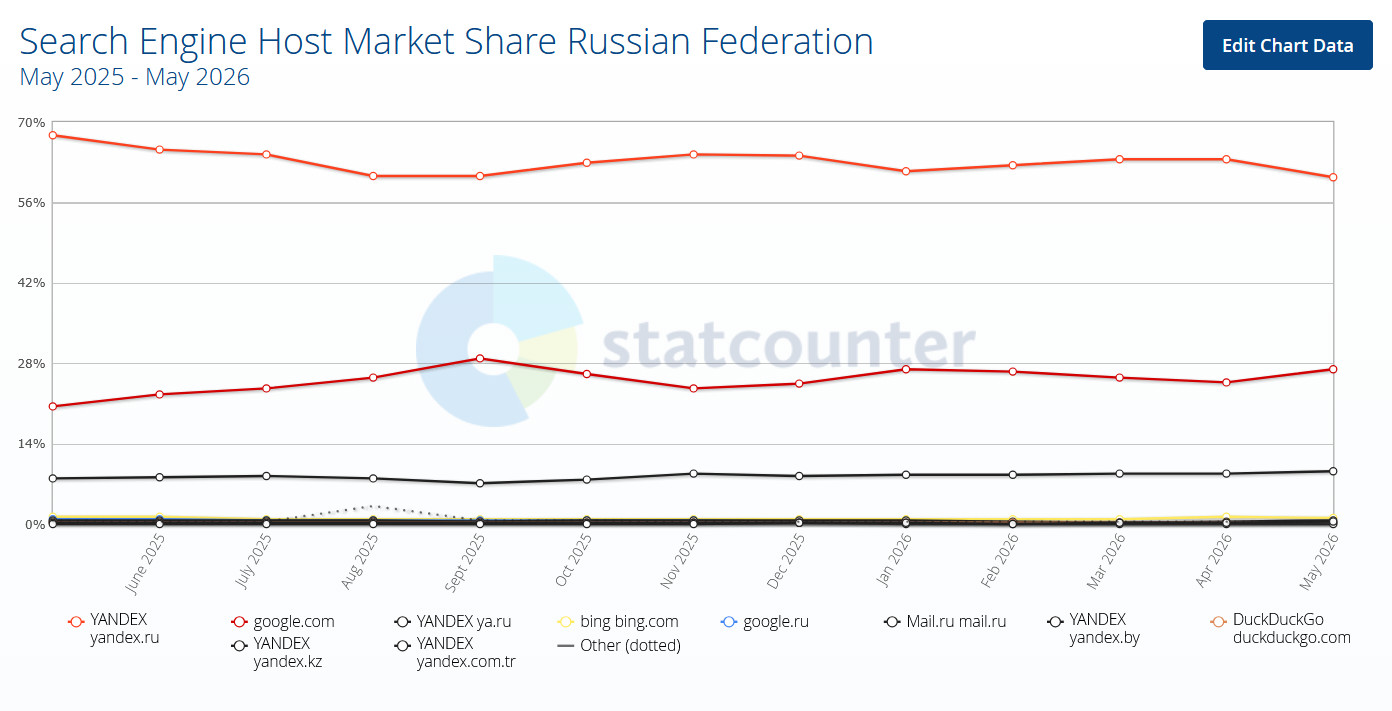
Yandex remains the primary gateway to paid search and organic traffic inside Russia. International and local brands use it to grow their reach and drive sales within the country. Google continues to matter as a search engine and as a channel for reaching audiences in external markets. However, since 2022, its advertising capabilities to target users within Russia have been significantly restricted.
Yandex, Google, and New Entrants: What Changed by 2026
The Russian advertising market has undergone a substantial restructuring. By 2026, the real competition is no longer just between Yandex and Google. Classic search now competes directly with AI-generated answers appearing in search results.
VK (Russia's largest social media network) continues developing its own advertising platform for paid social and video. Major marketplaces, including Ozon, Wildberries, and Yandex Market, now sell ad inventory directly within their storefronts and are rapidly maturing into full retail media platforms.
Messaging apps represent a particularly sensitive topic. Telegram remains one of the key channels for content distribution and community building. Since 2026, however, Russia has applied technical restrictions to the service. In parallel, the government actively promotes a national messenger called MAX, which has already registered more than 120 million users. Its advertising market is taking shape, though the platform has not yet launched a native self-serve ad interface.
Generative Answers and the New SEO Priority: AEO Alongside Classic SEO
Both Yandex and Google now display AI-generated answers directly in search results. Instead of the familiar list of links, users see a ready-made, detailed response that the AI assembles from multiple sources. This pulls traffic away from brands. Only about 1% of users click on the source hyperlinks embedded within these AI summaries.
A distinct professional discipline has emerged around this: AEO (Answer Engine Optimization) and the closely related GEO (Generative Engine Optimization). At its core, this is still SEO work, but with a new objective. The goal is no longer simply to rank at the top of search results. Brands now need to become a convenient source for AI-generated answers, so that the AI engine can pull a paragraph, a list, or a table from their site and cite it directly in its response.
Why Yandex Is the Logical Choice for Brands in Russia
In 2026, Yandex remained the primary entry point for search traffic and paid advertising inside Russia. It is the most direct route to broad reach, performance campaigns, and measurable results at the level of leads and sales.
A Full Format Stack on One Platform
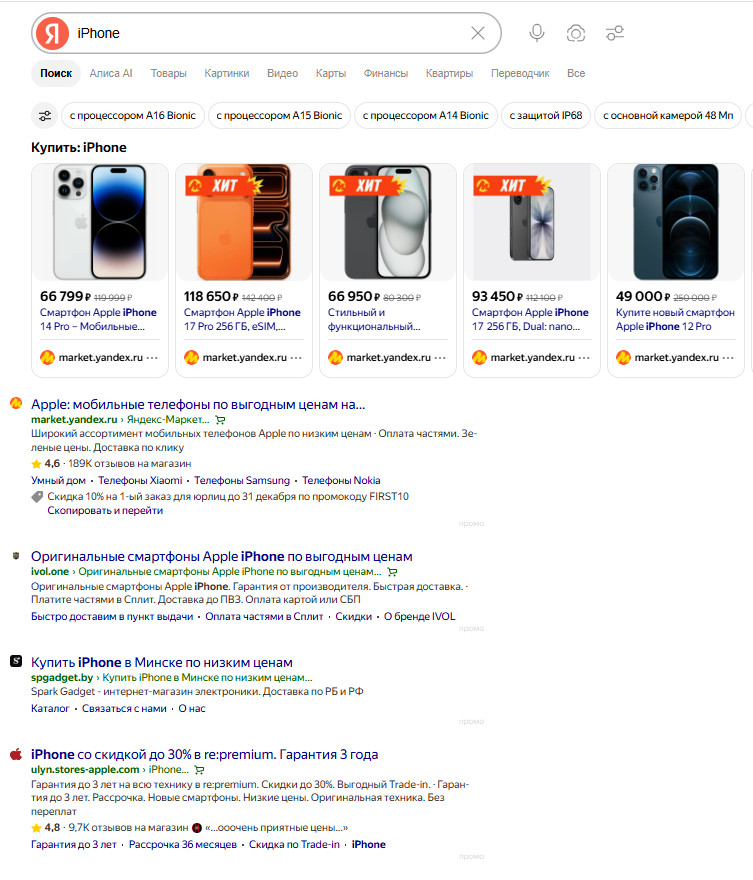
Yandex paid search (Russia's main PPC platform and Google's primary domestic competitor) gives brands the most direct access to high-intent audiences. Ads appear at the exact moment a user types a query related to a brand's product or service, reaching people precisely when their purchase intent is highest.
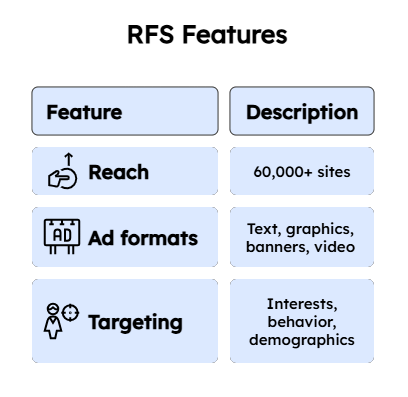
The Yandex Advertising Network (YAN) delivers broad reach beyond search. Daily audience figures across YAN partner sites range from 65 to 110 million users, depending on the source. Brand awareness and demand generation campaigns run through display banners, video, native formats on news sites, vertical media, Yandex's own services, and mobile apps. Users may not be actively searching yet, but they encounter the brand regularly within their everyday content environment.
This is what display advertising looks like on a typical site within the Yandex Advertising Network. Banners at the top and on the right side of the page represent one of the available ad formats
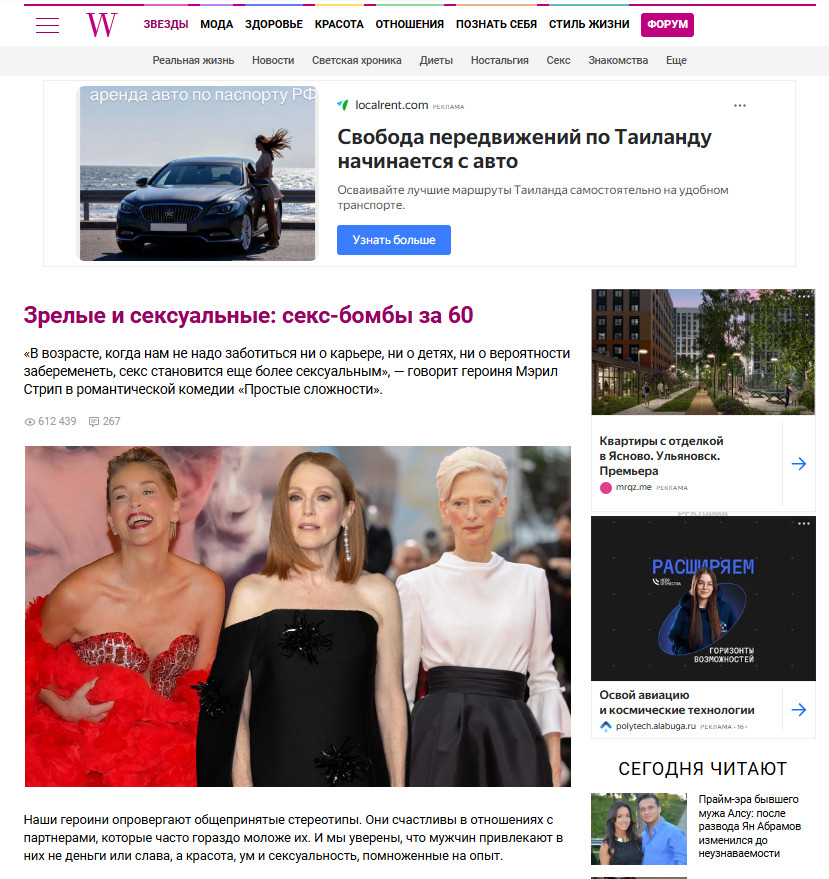
A car rental service placed a display banner through the YAN auction on a CPM (cost-per-thousand-impressions) basis. A typical branded media campaign running in a women's lifestyle publication. On the right, display banners from real estate developers and an industrial company
When to Use Each Format
In a working strategy, display and paid search advertising operate as a pair. YAN builds interest and increases contact frequency, while search captures conversions from users who are already ready to buy.
When launching a new product or entering the Russian market, YAN quickly builds brand awareness through high-reach banners, video, and native formats on relevant partner sites. During peak demand periods, including holiday sales, peak travel season, and back-to-school campaigns, paid search captures users with the strongest purchase intent.
Programmatic as the Default
Programmatic advertising through Yandex has become a central pillar of digital media buying in Russia. By 2026, auction-based purchasing is the dominant method for acquiring digital ad inventory in the country. Industry estimates suggest that large brands now route between 70% and 100% of their online advertising budgets through these channels. In specific segments, including mobile advertising, digital out-of-home (DOOH), and large-scale display placements, the share of automated impressions exceeds 70–80%.
Ads are purchased through real-time auctions, where algorithms select the right audience based on dozens of precise parameters. For advertisers, this delivers sharper targeting, faster campaign launches, and, in many cases, a better cost per result compared to manually buying inventory in traditional media.
A significant share of programmatic impressions in Russia flows through the Yandex Advertising Network. Everything running within it, including banners, text ads, in-app formats, and video, operates as paid inventory bought through automated auctions. This is not traditional direct media buying. It is an auction-based system built into the core logic of Yandex Direct (Yandex's primary self-serve advertising platform).
When an advertiser launches a campaign in YAN, they define their goals and constraints, then hand bid management and audience selection to Yandex's automated bidding strategies. In programmatic mode, Yandex algorithms analyze user behavior, interests, location, device type, search history, and more. Based on those signals, ads reach the users most likely to take a target action, whether that is a click, a site visit, a form submission, or a purchase.
This approach has become the default within the Yandex Advertising Network, and it is what gives brands working in the Russian market both broad reach and consistent traffic control.
In-App Advertising and the Mobile Focus
In-app formats have become one of the key channels for both reach and performance. This market is growing rapidly in Russia, where 85% of the population owns a smartphone. Some 45% of users are willing to watch ads within apps in exchange for free access, and 87% say they would choose a free, ad-supported app over a paid, ad-free alternative when given the option.
Through Yandex, brands can buy impressions within mobile applications. For brand awareness, they can run video and full-screen formats inside popular entertainment and utility platforms. For performance objectives, clickable banners and native formats drive users to a landing page, a brand's own digital product, or a product listing on a marketplace.
The core advantage of in-app advertising is the deep-attention context. The user is already focused on a task, whether gaming, using a service, or browsing products. A well-integrated creative has a real opportunity to capture that attention without causing friction.
Regional, Behavioral, and Commercial Targeting
In a country as geographically varied as Russia, regional audience selection is one of the most important tools for effective advertising. Yandex Direct (Yandex's main paid advertising platform) allows advertisers to go beyond city or region-level parameters and reach users within specific urban clusters and local delivery zones. This is especially valuable for retail chains, local service providers, and brands testing distinct offers across multiple regions.
Yandex applies its own geolocation and behavioral analysis algorithms, giving advertisers the ability to focus on regional preferences and local user behavior with considerably greater precision.
Commercial segmentation adds another layer. The platform analyzes which products and services a user browses, which categories they explore, how often they add items to their cart, and how frequently they complete purchases. Based on these signals, Yandex automatically builds high-commercial-potential audiences and serves them more precise offers, ranging from specific SKUs and promotions to personalized selections matched to their average order value and purchasing patterns.
By 2026, this work runs on neural models that help the system better understand user intent. Regional, behavioral, and commercial targeting increasingly operate together. The AI analyzes geography, context, and the commercial value of the audience simultaneously, delivering fewer random visitors and more genuine buyers.
Yandex Direct: The Platform for Growing Brands in Russia
In 2026, Yandex will remain one of the most reliable and predictable performance advertising tools available in Russia. It is fully accessible to businesses, deeply integrated with analytics, and provides clear visibility into how every ruble performs across campaigns, audience segments, regions, and creatives. For international brands entering the country, it is effectively the default channel, delivering reach, control, and transparent economics.
One example worth noting is Banyan Residences Villas Hua Hin, a luxury property developer from Thailand that entered the Russian market through a campaign built by the RMAA Agency. The campaign ran on Yandex Direct using paid search, YAN display, and retargeting. Through precise localization and careful audience segmentation, it generated more than 240 qualified leads at a cost per lead below the initial target. The full case study is available on the RMAA Agency website. It illustrates how a well-constructed media mix within the Yandex ecosystem can produce concrete business results.
Campaign management matters more than ever. Advertising on Yandex has grown more expensive and more complex. Rising competition, the shift to automated bidding strategies, and the growing role of AI mean that 'launch and leave' no longer works. Without a clear strategy and ongoing optimization, the system starts collecting cheap but non-commercial traffic, clicks, and impressions that look strong in a report but never turn into sales.

"Today, Yandex Direct is not a button you press to run ads. It is a complex ecosystem where algorithms operate by default. Leave a campaign unmanaged, and the platform will do exactly what it is designed to do: maximize clicks within the constraints you set. But clicks and business results are not the same thing. Based on our experience, without a clear strategy, clean analytics, and continuous optimization, between 40% and 60% of the budget can easily flow into traffic that will never become sales. That is precisely why international brands working in the Russian market benefit from partnering with local specialists who understand the logic behind Yandex's algorithms and know how to work with them effectively."
Yandex remains the primary entry point for search and paid traffic in Russia, but success depends not only on the platform itself. It depends on who manages it and how. The right strategy, local expertise, and consistent data work turn a complex, competitive environment into a manageable source of leads and sales. This is where an experienced Russian market partner makes a meaningful difference.
Google in 2026: A Supporting Channel, Not a Primary Growth Driver
Google search remains visible in Russia. According to Statcounter and industry analyses, it accounts for roughly 25–30% of search queries in the Russian internet segment across 2024–2026. The trend, however, continues downward: Google has been losing share both globally and within Russia over recent years.
At the same time, the nature of search itself is changing. In 2026, more than 60% of Google queries end without a click, as AI overviews, featured snippets, and instant answers resolve user needs directly within the results page. This reduces the volume of visits to brand websites and further repositions Google from a primary traffic growth driver to a supporting channel for brand presence and credibility.
How to Use Google When Your Goal Is to Grow in Russia
For campaigns targeting Russian audiences specifically, Google plays a secondary role in 2026. Its advertising tools for reaching users within Russia are restricted, and brands generate most of their paid traffic through Yandex and local ecosystems.
That said, ignoring Google entirely is not the right approach. If the goal is growth in Russia, maintaining organic visibility and brand presence in Google still matters. This means keeping the site in strong technical condition, covering site speed, mobile-first indexing, and Core Web Vitals. Brands should also secure visibility for branded queries and monitor how they appear in search results, including the meta description snippet, Knowledge Panel card, and local listings. Some users will check a company through Google even if they ultimately take action within another platform or ecosystem.
If the objective is growth in Russia, Google in 2026 is about reputation, organic demand, and being present where users look for you. It is not about large-scale paid traffic acquisition. Primary budgets and testing should focus on Yandex, VK, and marketplaces.
Google Discover: Earning a Place in Recommendations
Google Discover remains a valuable source of supplemental mobile traffic, particularly for media outlets, blogs, and content-driven projects. In 2026, Google updated the Discover algorithm independently from its core search product for the first time. The service now favors less clickbait-driven headlines, quality local content, and authoritative publications.
To earn Discover traffic for a brand site, publishers need to meet several technical requirements: strong mobile optimization and Core Web Vitals scores (LCP, INP, CLS), high-quality images at least 1,200 pixels wide, and correct structured data markup using Article, NewsArticle, or BlogPosting schema along with author markup.
Content quality matters just as much. Headlines should be descriptive and accurate, reflecting the actual content without manipulation or sensationalism. Published material should carry genuine value through reviews, analysis, local case studies, and articles that connect with current audience interests. Key pieces should be refreshed regularly with updated statistics, new examples, and fresh visuals.
Brand authority and E-E-A-T (Experience, Expertise, Authoritativeness, and Trustworthiness) also play a role. Building the brand as a credible source means maintaining author profile pages, linking to social profiles, and earning mentions in authoritative publications. Structured data and strong internal linking help Google better understand the context of each piece and its connection to the topics where the brand wants to appear.
Treat Discover as a valuable bonus traffic source. It can deliver significant reach spikes, especially for content-driven projects, but it should not serve as the foundation of a business model or marketing strategy.
A Working Media Mix in Russia in 2026: Yandex, VK, Marketplaces, and Messengers
Effective promotion in Russia in 2026 rarely relies on just one or two channels. Instead, brands build a media mix from several local ecosystems, each with a distinct role.
Yandex sits at the center of this mix. It remains the primary paid platform for search and display advertising within the country, handles high-intent traffic, and delivers scalable reach through the Advertising Network and in-app formats. Yandex is the most practical place to build a performance funnel, measure results at the level of leads, orders, and LTV (Lifetime Value), and then align the other channels around that funnel.
VK serves as the main social and video platform. Users follow brands, watch short-form video, participate in communities, and engage with content creators. For marketers, VK is where brand awareness grows, engagement develops, and long-term audience relationships form. Brand image campaigns, native integrations with creators, and paid social on VK consistently support demand that subsequently registers in Yandex search and on e-commerce platforms.
Marketplaces such as Ozon, Wildberries, and Yandex Market cover the bottom of the sales funnel. These are the places where users arrive with purchase intent already formed. For brands, they function as full retail media platforms: advertising is built directly into the storefront, helping promote products and protect branded demand within the search bar. Campaigns running on Yandex and VK frequently point not only to brand websites but also to product listings, particularly when the goal is to convert audience attention into sales as quickly as possible.
Messaging apps complete the picture as retention and direct communication channels. Telegram remains a key tool for content distribution and community engagement, though regulatory uncertainty and technical restrictions around it have grown through 2026. In parallel, the national messenger MAX is gaining ground as the officially promoted alternative, with tight integration into government services. As a result, brands tend to use Telegram for fast, direct communication with their core audience, while MAX is emerging as a viable channel for notifications, customer service, and reaching broader audiences in a more regulated environment.
The picture for entering the Russian market looks like this: Yandex carries the primary load for paid traffic acquisition and intent-based targeting; VK builds awareness and engagement; marketplaces convert interest into purchases; and messaging apps retain and re-engage customers.
The real question is how to build the right combination of these ecosystems for a brand's specific objectives, whether that means a first market entry test or a full-scale growth push in Russia.
So, Where Does the Yandex vs. Google Question Actually Stand?
The Russian market no longer comes down to a choice between Yandex and Google, and it no longer runs on classic search alone. Yandex consistently holds a dominant share of queries and remains the primary paid channel for reaching Russian audiences. Google functions as a supporting tool for branded search, reputation management, and external markets.
For a brand entering Russia or rebuilding its strategy, the right approach looks like this: build the foundation of performance and SEO work around Yandex, account for generative answers and AEO, maintain a baseline presence in Google for credibility and organic visibility, and complement search with a local ecosystem that includes VK, marketplaces, and messaging apps. That combination delivers more than just search visibility. It produces measurable business results within the Russian digital environment of 2026.
The tools alone, however, no longer guarantee success. Advertising on Yandex has grown more expensive and more competitive. Algorithms optimize aggressively toward their own targets, and AI-generated answers are taking a portion of organic traffic. This is why international brands entering the market are better positioned when they work alongside a local partner who understands Russian audience behavior and knows how to operate across Yandex, VK, and marketplaces as a unified ecosystem.
RMAA Agency fills that role in Russia, helping brands adapt their strategy to local market realities, build the right media mix, and structure campaigns so that every ruble invested in Russian digital returns as leads and sales.
Iraida Mishina
History
Our experts continually monitor the marketing and advertising space, and we update our articles when new information becomes available.
-
Current Version